
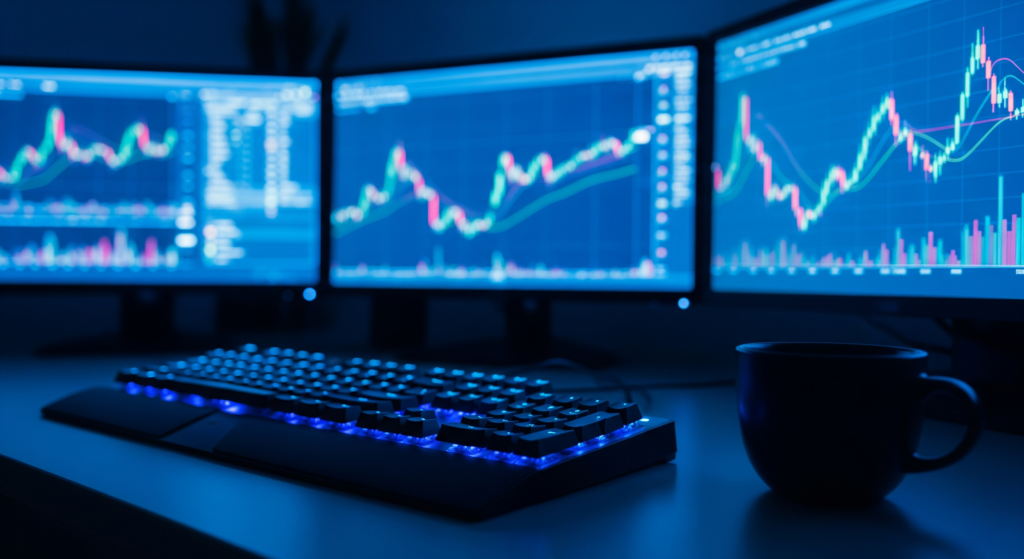
Master algorithmic trading in 2026. Discover top Python strategies, navigate US vs. Global regulations, and avoid AI bot scams in this comprehensive retail guide.
Introduction: Why You Can’t Beat the Bots (So You Should Join Them)
Have you ever stared at a chart, blinked, and missed a breakout by three seconds? Or hesitated to pull the trigger on a trade because you were “waiting for confirmation,” only to watch the price rocket without you?
You aren’t just fighting your own psychology; you are fighting math.
In 2026, the financial markets are no longer dominated by men in suits shouting on a floor. They are run by silent, ultra-fast servers. As of 2025, estimates suggest that 92% of Forex trading volume is executed by algorithms.1 In the US stock market, between 60% and 73% of all trades are automated.
But here is the good news: the walls have come down. What used to require a PhD and a $10,000/month Bloomberg terminal is now accessible to you. Retail investors now account for approximately 43% of the global algorithmic trading market.
Algorithmic trading is simply the use of computer programs to execute orders based on predefined criteria like timing, price, and volume. This guide will walk you through building your first “bot,” choosing the right tech stack, and navigating the complex web of global regulations—whether you are in New York, London, or Singapore.
The State of the Automaton’s Market in 2026
The landscape has shifted dramatically since the infamous “Flash Crash” of 2010, where a single algorithm helped plunge the Dow Jones nearly 1,000 points in minutes. Today, the market is faster, but also more accessible.
From Wall Street to Main Street
The “retail revolution” is being driven by three factors:
- Zero-Commission Trading: Reduced friction for high-frequency strategies.
- Open Source Libraries: Python tools like
PandasandLumibotmake coding accessible. - AI Assistants: Generative AI can now write boilerplate trading code, lowering the barrier to entry.
Core Algorithmic Strategies: The Math Behind the Money
You don’t need complex machine learning to start. Most successful algorithms rely on simple, robust logic. Here are the three pillars:
1. Trend Following: Catching the “Fat Tails”
This strategy assumes that assets in motion tend to stay in motion. You aren’t predicting the future; you are reacting to the present.
- The Logic: Buy when the price crosses above a moving average (e.g., 50-day SMA). Sell when it crosses below.
- Pros: Captures massive market moves (fat tails).
- Cons: Suffers “whipsaws” (losses) in sideways markets where the price chops back and forth.
2. Mean Reversion: Betting on the Bounce
This assumes that price deviations are temporary and will return to an average “fair value.”
- The Logic: If a stock’s RSI (Relative Strength Index) drops below 30, it is “oversold”—buy it. If it goes above 70, it is “overbought”—sell it.
- The Danger: “Catching a falling knife.” Sometimes a stock is cheap because the company is failing, not because of market noise.
3. Arbitrage: The DeFi Frontier
Arbitrage exploits price differences for the same asset across different markets.
- Crypto Context: A token might trade for $100 on Uniswap and $102 on Binance. An algorithm buys on Uniswap and instantly sells on Binance.
- Risk: In 2026, “MEV Bots” (Miner Extractable Value) front-run these trades, and transaction fees can eat your profits instantly.
Building Your Tech Stack: Tools of the Trade
If you are building a house, you need a hammer. If you are building a bot, you need Python. It is the undisputed language of finance due to its massive ecosystem of data libraries.
Essential Python Libraries
- Pandas: The Excel of programming. Essential for organizing historical price data.
- TA-Lib / Pandas-TA: Used to calculate technical indicators (RSI, MACD, Bollinger Bands) instantly.
- Lumibot / Backtrader: Frameworks that let you “backtest” your strategy against historical data to see how it would have performed.
Broker Showdown: Who Holds Your Money?
Your choice of broker determines your execution speed and costs.
| Feature | Interactive Brokers (IBKR) | Alpaca |
| Best For | Professionals & Global Traders | Developers & Beginners |
| API Quality | Powerful but complex (TWS API) | Modern, easy-to-use REST API |
| Markets | Stocks, Options, Futures, Forex (Global) | Mostly US Stocks & Crypto |
| Data Cost | Paid feeds required for quality | Free basics, paid for SIP real-time |
The Hidden Costs
Beginners often ignore the “invisible” killers of profit:
- Slippage: The difference between the price you want and the price you get.
- VPS (Virtual Private Server): You cannot run a bot on your laptop; if your WiFi cuts out, you lose money. You need a 24/7 cloud server.
- Data Feeds: Free Yahoo Finance data is often delayed or riddled with errors. Professional feeds (like Polygon or Kibot) are a monthly fixed cost.
Global Rules of Engagement: Where You Live Matters
This is critical. Your location dictates what you can trade and how much money you need.
The US Trader’s Hurdle: The PDT Rule
If you are in the United States, FINRA Rule 4210 is your biggest obstacle.
- The Rule: You are a “Pattern Day Trader” if you make 4+ day trades in 5 days.
- The Barrier: You must maintain a minimum account balance of $25,000.
- The Workaround: Trade futures or Forex (which are exempt), or use a cash account (which slows down capital recycling).
The European Advantage: CFDs
Traders in the UK, Europe, and Australia often use Contracts for Difference (CFDs).
- Benefit: No PDT rule. You can day trade with £500.
- Risk: CFDs are highly leveraged derivatives. You don’t own the underlying stock, and you can lose money rapidly.
Asia-Pacific: The Regulated AI Frontier
- Singapore: The Monetary Authority of Singapore (MAS) has released specific guidelines on “AI Risk Management” (2025), focusing on explainability. Financial institutions must be able to explain why their AI made a trade.
- Hong Kong: The SFC now allows retail access to large-cap crypto assets but requires strict onboarding and knowledge tests to prevent “blind” algorithmic speculation.
The Future is Now: AI and Generative Code
In 2026, you can ask an LLM to “Write a Python script that buys Apple when the 50-day moving average crosses the 200-day.”
The Benefit: It drastically lowers the barrier to entry for non-coders.
The Risk: Hallucinations.
AI models can invent Python libraries that don’t exist or write logic that looks correct but fails in edge cases (e.g., calculating position size based on the wrong variable). Never deploy AI-generated code without auditing it line-by-line.
Warning: Beware of “Black Box” AI trading bot scams. If a platform promises “guaranteed returns” using “Quantum AI,” it is a scam. Legitimate algorithmic trading is about probability, not guarantees.
Risk Management: How to Not Blow Up Your Account
Your primary job is not to make money; it is to protect your capital.
- Avoid Overfitting: If your backtest shows a straight line up, you are lying to yourself. You likely “tuned” your strategy to fit past noise rather than finding a real signal.
- The Kill Switch: Every bot needs a hard-coded “panic button.” If you lose X% of your account in one day, the bot must shut itself down automatically.
- The “Set and Forget” Fallacy: Algorithms degrade. Market conditions change. You must monitor your bots daily. Passive income in trading is a myth.
Conclusion: Engineering Your Financial Edge
Algorithmic trading is a marathon, not a sprint. It replaces emotional decision-making with statistical discipline, but it requires an engineering mindset.
Your Action Plan:
- Learn Python: Focus on
Pandasand data handling. - Pick Your Market: US Stocks (if you have $25k+), Forex/Futures, or Crypto.
- Backtest: Use
LumibotorBacktraderto validate your idea. - Paper Trade: Run your bot for a month with fake money to test execution.
- Go Live Small: Start with the minimum capital you can afford to lose.
The tools are in your hands. The rest is up to your code.
Frequently Asked Questions (FAQ)
1. Can I start algorithmic trading with $100?
Yes, but your options are limited. In the US, you are restricted by the PDT rule for stocks, so you might look into crypto or fractional shares. In the UK/EU/Australia, you can use CFDs with small capital, but leverage adds significant risk.
2. Is Python or C++ better for trading?
For 99% of retail traders, Python is the best choice because it is easier to learn and has vast libraries. C++ is primarily used by high-frequency trading (HFT) firms where every nanosecond of speed counts.
3. What is the biggest risk for beginners?
Overfitting. This happens when you create a strategy that works perfectly on past data but fails in the real world because it was “memorizing” history rather than finding a repeatable pattern.
4. Are AI trading bots legal?
Yes, automated trading is legal in most major jurisdictions. However, selling a bot that promises guaranteed returns or using bots to manipulate market prices (spoofing) is illegal and heavily regulated by bodies like the SEC, FCA, and MAS.
5. How do I get historical data for backtesting?
You can get free daily data from Yahoo Finance (via yfinance), but it may have errors. For serious trading, providers like Polygon.io or Databento provide reliable, high-quality historical data for a monthly fee.